

FABRICATION OF A REPLACEMENT SELF-UNLOADER ORE CONVEYOR BOOM
fabricaton Location: Everett, Washington
Project Overview
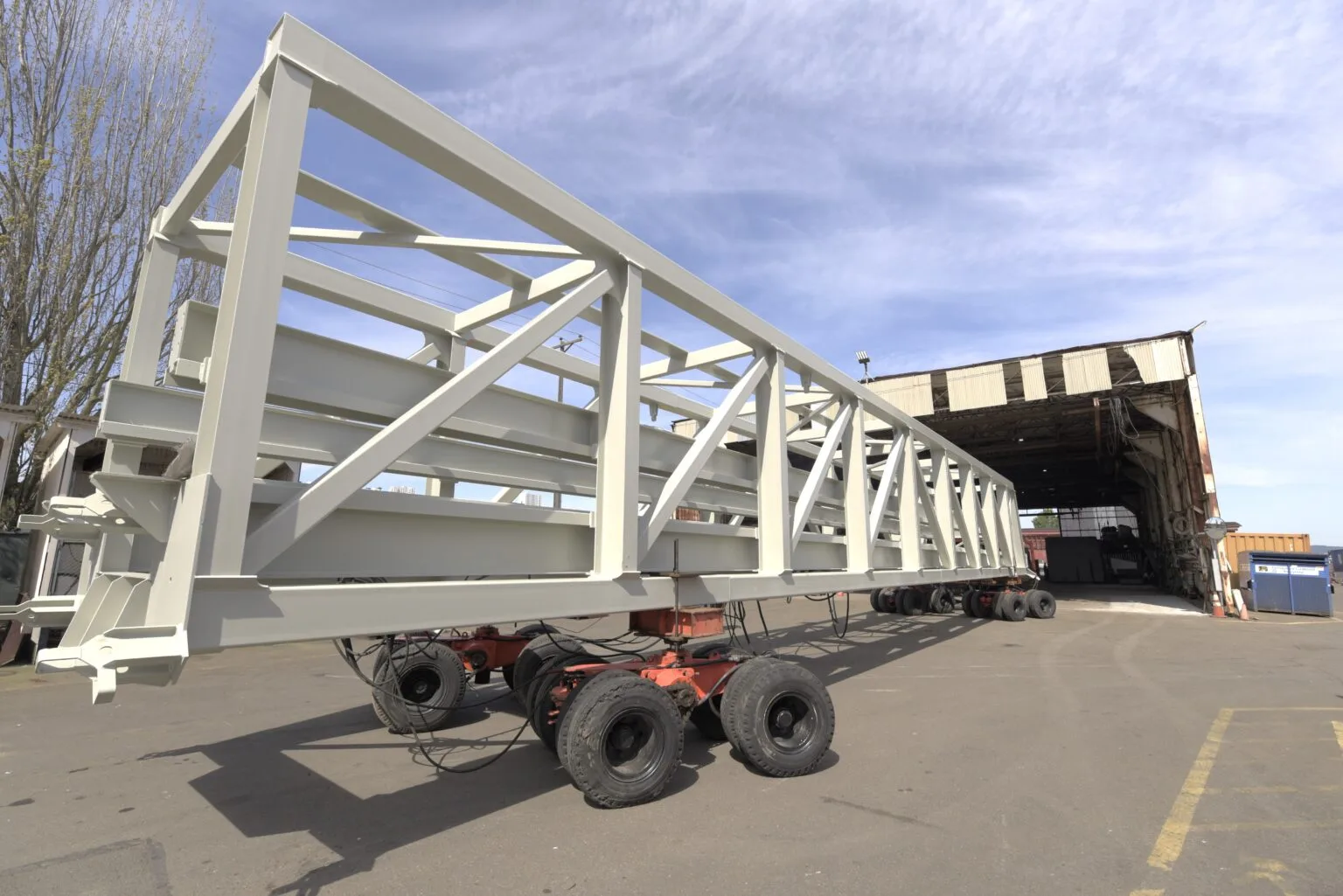
Nordholm Companies developed a detailed fabrication package and fabricated a replacement self-unloader ore conveyor boom for integration with an existing marine lightering barge.
The approximately 77-foot-long boom incorporated more than 75,000 pounds of structural and mechanical assemblies. The completed system combined large, fully welded steel trusses with close-tolerance pivot and luffing components, conveyor-support assemblies, shuttle tracks, and maintenance access systems.
Nordholm’s scope included the primary boom structure, top and bottom panels, side trusses, near- and far-side shuttle tracks, door and sheave assemblies, luffing attachment, idler supports, drive and pulley supports, walkways, platforms, and railings.
The Challenge
The existing boom had reached the end of its service life, but the replacement still had to match critical interfaces on the existing barge equipment.
The new structure was required to retain the established boom geometry and an enlarged hopper arrangement while connecting to the existing turret pivot, luffing cylinder, shuttle, and conveyor-system components. Because the available legacy drawings were not guaranteed to be complete or accurate, critical dimensions and material requirements had to be verified before fabrication.
The scale of the structure added another level of complexity. Alignment had to be maintained throughout the approximately 77-foot boom while preserving the geometry of its structural, conveyor, pivot, and luffing interfaces
-
Approximately 77-foot boom length
-
More than 75,000 pounds of structural and mechanical assemblies
-
Fully welded structural-steel truss construction
-
Custom-machined pivot pins, sleeves, bearing housings, and luffing components
-
Integrated shuttle tracks, door systems, sheaves, idler supports, and pulley supports
-
Fabricated walkways, platforms, and safety railings
-
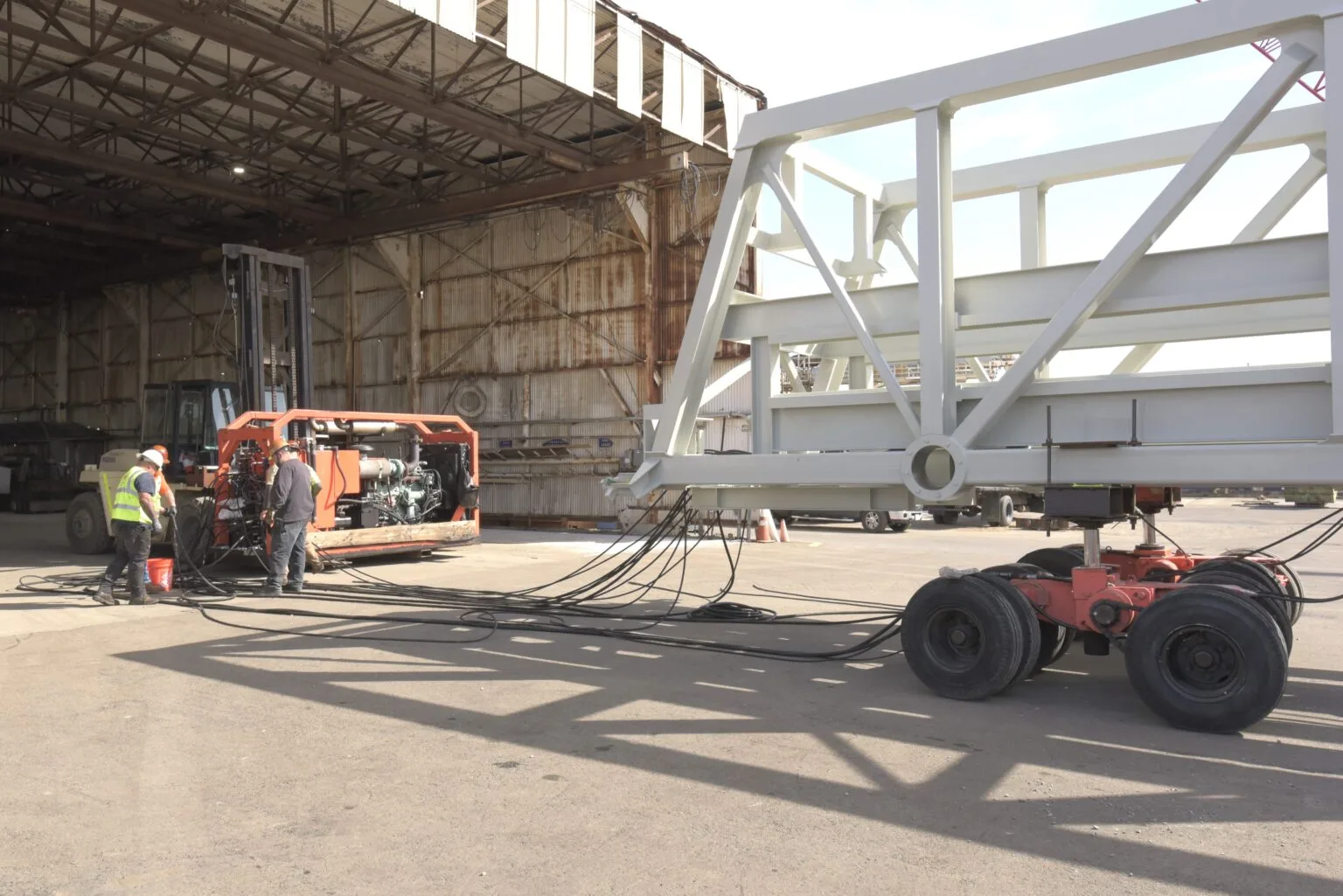
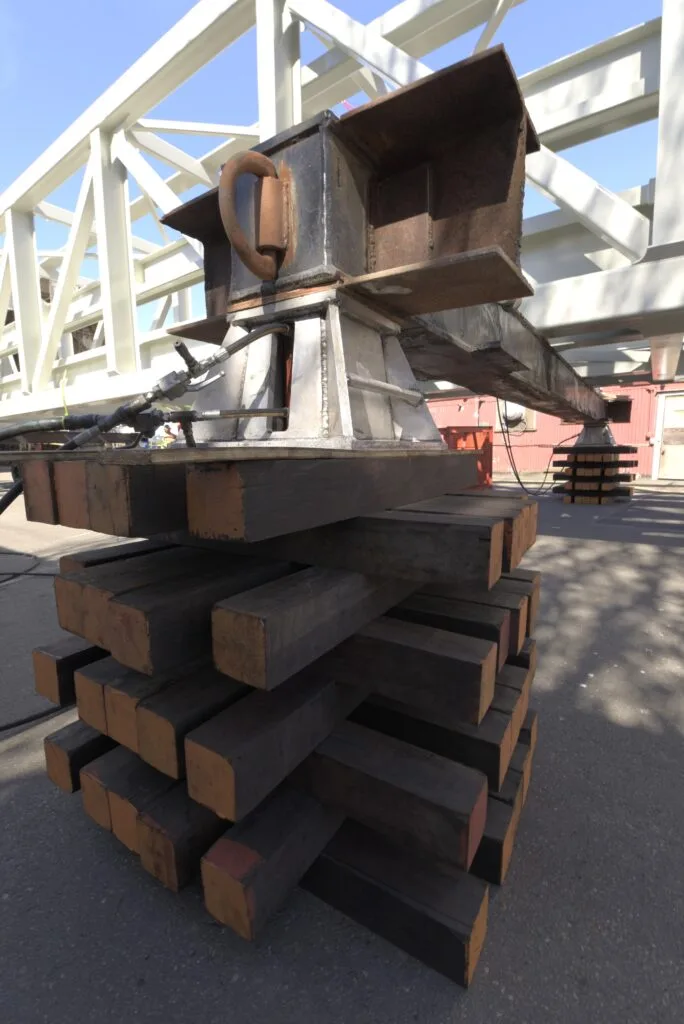
Controlled loadout using Nordholm dollies and HPU, Ekki cribbing, and 55-ton self-climbing jacks
The Solution
Nordholm translated the existing-equipment requirements into a detailed, component-level fabrication package. The boom was divided into controlled structural and mechanical subassemblies for fabrication, fit-up, and final assembly.
The primary structure incorporated fabricated tubular-steel trusses, wide-flange members, channels, platework, brackets, and stiffeners.
The structure also incorporated custom-machined pivots and luffing components, including large-diameter pins, sleeves, and bearing housings. These components were developed and fabricated to maintain the critical connection geometry between the new boom and the barge’s existing equipment.
After structural and mechanical assembly, the completed boom was prepared for protective coating and heavy transportation to the customer’s facility.
Nordholm fabricated the boom as a fully welded structural-steel assembly using fillet, butt, and complete-joint-penetration (CJP) weld details per AISC and AWS standards. Critical truss-to-pivot bearing-housing connections incorporated CJP welds and were carried through the tubular trusses, panels, crossmembers, shuttle tracks, luffing attachment, walkways, platforms, and related structural assemblies.
Following fabrication, a 14-position FARO laser scan of both Ore Booms was performed. The 14 individual laser scans were aligned and combined to create a complete three-dimensional digital representation of the boom, and were compared with the design model, the retired 30-year boom, and both fabricated Booms to evaluate key overall dimensions, pivot-bearing alignment, and shuttle-track geometry.
The comparison found that both pivot-to-end dimensions were within the report’s 1/2-inch comparison tolerance and the measured shuttle-track geometry was within specifications.
Following dimensional verification, the boom, bolt-on components, and handrails were abrasive blasted to an SP 10 near-white-metal level of preparation.
The prepared steel received a three-coat protective coating system consisting of one full coat of zinc primer, one full coat of high-solids epoxy primer, and one full coat of gloss urethane topcoat. The combination of near-white-metal surface preparation and multiple protective coats was designed to provide a durable, corrosion-resistant finish suitable for the boom’s marine operating environment.
Equipment Used/Fabricated
77-foot replacement self-unloader Ore conveyor boom and executed the controlled loadout using company-owned hydraulic dollies, Ekki cribbing, and 55-ton self-climbing jacks